Too often, designers assume that the words «explosion-proof» or an IECEx/ATEX label are sufficient to guarantee compliance in hazardous environments. This assumption is incorrect and even dangerous.
In Canada, compliance with hazardous location standards must meet CSA C22.1 and C22.2 No. 60079 standards from the CSA Group, and only certification bodies (CBs) accredited by the Standards Council of Canada (SCC) can approve an IECEx test report (ExTR). These reports must be re-evaluated and certified in accordance with Canadian or American codes.
IECEx is a useful reference, but it is not a certification.
Gas, dust... and everything in between
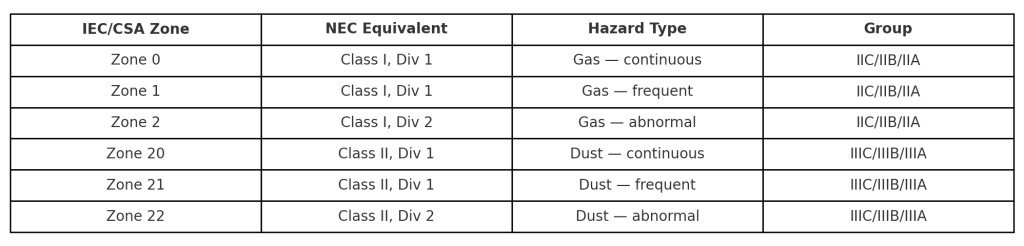
Canada now uses the zone classification system, harmonized with IEC/ISO 60079, while the United States still mainly uses the class/division system of NFPA 70.
Here's what you're dealing with:
It's not just the speaker
Even a fully certified speaker can become a source of ignition if it is:
- Installed in a non-approved enclosure.
- Connected using non-compliant conduits or cable glands.
- Poorly connected or poorly grounded.
- Powered by wiring that may produce an electric arc in the event of a fault.
We go beyond devices.
At CSX Group Inc., we work with our customers to ensure that all sound, general alarm, and voice alarm infrastructure is safe and compliant with standards:
- Validate hazard classifications (gas and dust)
- Select the appropriate speakers, enclosures, and mounting hardware.
- Check the IP rating, T code, and gas/dust group for all components, not just the end devices.
Hazardous areas don't forgive shortcuts. From battery rooms and propane enclosures to grain silos and hydrogen plants, we help you design safe, complete, and compliant systems, from speakers to conduits.