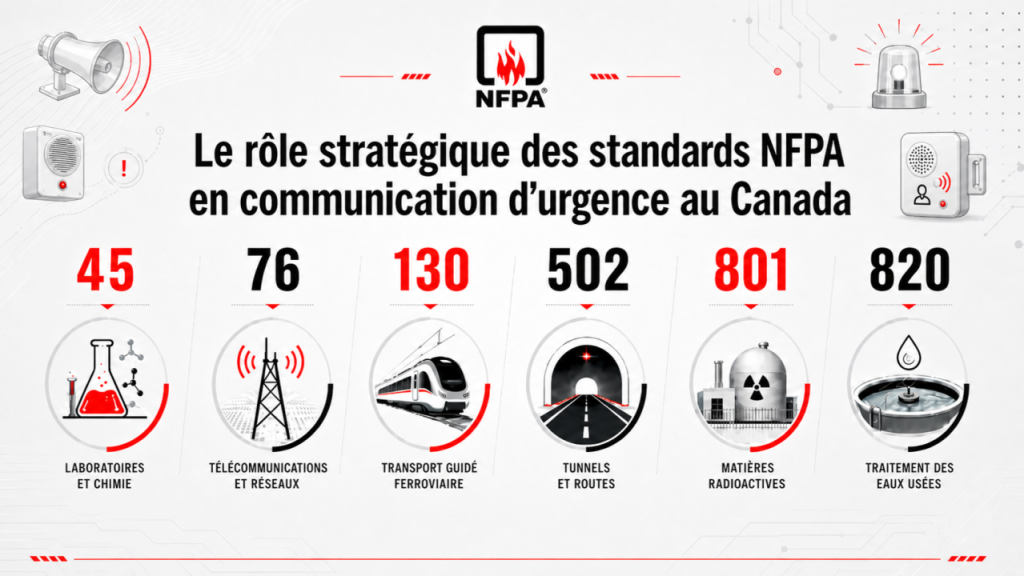
The Canadian regulatory framework for fire safety and soundproofing rests on a clearly identified foundation: National Building Code, National Fire Code, and the CAN/ULC suite of standards. This foundation is sufficient for the vast majority of buildings. It is less so for mass notification as a system, and even less so for certain types of premises where emergency communication comes up against specific constraints: chemical laboratories, telecommunications facilities, transportation infrastructures, nuclear installations, wastewater treatment plants.
For these situations, several NFPA standards can complement the national framework. Understanding how they relate to Canadian regulations has become an integral skill in the design and evaluation of emergency communication systems.
The Canadian base and its limits
In Canada, regulatory compliance in detection, fire alarm and emergency voice communication requires a coherent set of standards. The NBC and NFC are model codes published by the Canadian Commission on Building and Fire Codes, established by the National Research Council of Canada (NRC). Their force of application depends on their adoption, in a given edition, by each province or territory, generally with local modifications. In Quebec, the Code de construction du Québec (CCQ) adopts the NBC with its own modifications. In Ontario, the Ontario Building Code (OBC) follows a similar logic. This edition-by-edition, jurisdiction-by-jurisdiction adoption mechanism is in itself a layer of complexity that any major project needs to map out from the outset.
The technical side is based on the CAN/ULC suite of standards, whose names have recently been harmonized by removing the «S» prefix. CAN/ULC-524 covers the installation of fire alarm systems, CAN/ULC-525 audible devices, CAN/ULC-526 visual devices, CAN/ULC-527 control units and accessories, and CAN/ULC-541 loudspeakers. CAN/ULC-536 and CAN/ULC-537 govern periodic inspection and commissioning verification. For mass notification, CAN/ULC-576 covers the equipment, and CAN/ULC-573 its installation as an auxiliary system interconnected to the fire alarm. CAN/ULC-1001 deals with integrated testing, which is essential when several security systems need to be interoperable.
The scheme covers most commercial, institutional and industrial buildings in the broadest sense. It defines thresholds, measurement methods, compliance tests and performance requirements.
However, it has two structural limitations:
The first concerns mass notification itself. CAN/ULC-576 standardizes the equipment, CAN/ULC-573 its installation as an auxiliary system, and CAN/ULC-1001 the integrated tests. No Canadian standard, however, dictates the design and test methodology of a MNS as a system, i.e. prior risk analysis, message prioritization, notification mode architecture, acoustic performance and intelligibility criteria per space, validation scenarios.
The second limitation relates to the nature of the assets. The general framework does not address, with the required granularity, certain asset configurations: atypical geometry, adverse acoustic environment, presence of hazardous materials, high operational criticality, long-distance evacuation requirements.
Where NFPA standards can take over
NFPA 72 - National Fire Alarm and Signaling Code
NFPA 72 remains the North American benchmark for fire alarms and, since the introduction of Chapter 24, for emergency communication systems (ECS) and mass notification systems (MNS). This chapter bases design on a preliminary risk analysis, and distinguishes between several types. It sets out requirements for design methodology, message prioritization, performance, redundancy and testing.
In Canada, when cited in a technical specification, required by an insurer or adopted as good practice by the designer, NFPA 72 provides the methodology that has no direct equivalent in the CAN/ULC standards for these components. It is not required by default, but is frequently used to bridge the gap between CAN/ULC-576 (equipment) and CAN/ULC-573 (installation as an auxiliary system to the fire alarm).
NFPA 45 - Chemical laboratories
Chemical laboratories present an unfavorable environment for broadcasting an emergency message: fume cupboard noise, high-flow ventilation, compartmentalized spaces, presence of materials incompatible with certain evacuation scenarios. NFPA 45 does not prescribe specific notification, but it does codify the operating environment and design constraints that any emergency communication system must take into account in these spaces. For Canadian universities, research centers and pharmaceutical facilities, it provides a background reference that is essential to the coherent design of an MNS or ECS.
NFPA 76 - Fire protection for telecommunications installations
Telecommunications installations have a dual role to play: protection of the asset itself, and continuity of critical communications functions on a regional or even national scale. NFPA 76 covers early detection, separation of functions, and the link between internal signaling and operational continuity. For Canadian operators and critical data centers, it can serve as an implicit reference for contractual and insurer requirements, as CAN/ULC standards do not cover the sectoral depth of this standard.
NFPA 130 - Passenger rail systems
Trains, subways, streetcars, commuter trains: NFPA 130 addresses emergency communication requirements in stations, tunnels and rolling stock. Long-distance evacuation, intelligibility constraints in reverberant spaces, redundancy with operating systems, interfacing with control centers - these are all issues that neither the NBC nor the CAN/ULC suite address at this level of specification. In Quebec, as in the rest of Canada, most major passenger rail projects are based on NFPA 130, sometimes in the absence of any equivalent local reference.
NFPA 502 - Road tunnels, bridges and limited access roads
Road tunnels combine acoustic constraints (extreme reverberation, traffic, ventilation), degraded radio propagation, and an evacuation scheme unlike any building. NFPA 502 sets out emergency communication requirements for users, emergency services and coordination with traffic management systems.
NFPA 801 - Facilities handling radioactive materials
The Canadian nuclear sector, from operating plants to research facilities and decommissioning sites, operates under the supervision of the CNSC, with a distinct regulatory framework. NFPA 801 specifies requirements in contexts where the detection-notification-operator response sequence is critical, and where message errors have immediate consequences.
NFPA 820 - Wastewater treatment systems
Wastewater treatment plants present a combination of risks not commonly found in standard buildings: potentially explosive atmospheres (methane, hydrogen sulfide), confined spaces, distribution over large areas. NFPA 820 deals with detection-notification adapted to these environments, in particular the coherence between gas detection, fire alarm and notification of operating personnel. For Canadian municipalities in the process of modernizing their facilities, it represents a relevant reference that the CAN/ULC suite does not replace.
Other specialized NFPA standards may come into play depending on the asset class (airport facilities, underground, warehouses). The logic of complementarity remains the same.
The question of normative force
The presence of an NFPA standard in a Canadian project raises a legal question that is rarely explicitly addressed: how strongly does it apply?
In practice, there are four possible scenarios.
- Visit contractual reference, When the project owner imposes it in his specifications, it becomes an obligation in the same way as any other requirement.
- L’insurer requirement, when the policy explicitly cites the standard, and failure to comply with the standard triggers coverage.
- Visit reference of expertise, When the designer invokes it as good practice to fill a gap in the Canadian framework, it has a lesser legal scope, but a decisive value in defending a design in the event of a claim.
- Visit recognition by the competent authority finally, when the AHJ accepts the standard as equivalent or complementary to local requirements, a recognition which must be formalized in the safety file.
This qualification must be carried out early in the project and documented in the design file. An NFPA standard quoted without qualification of its force of application creates an ambiguity that reveals itself at the worst possible moment, either during the commissioning phase, or post-incident.
Conclusion
The Canadian framework, i.e. the NBC and NFC model codes as adopted by each province and territory, and the CAN/ULC suite of standards, is not in competition with NFPA standards. It is the legal basis, and the NFPA standards are, for the design of NSMs and for certain asset classes, the technical extension when they are contractually, regulatory or professionally invoked. Professional competence does not consist in choosing between the two, but in knowing when and how to articulate the two corpuses to produce a coherent, defensible and traceable design.
For owners of laboratories, transport infrastructures, telecoms installations or wastewater treatment plants, the question is no longer simply «Are we compliant with the standards? but »Which specialized normative standard applies to us, and how does it translate into our technical requirements?.
It is this articulation, rather than mere compliance with the base, that distinguishes a robust design file from a minimal design file.