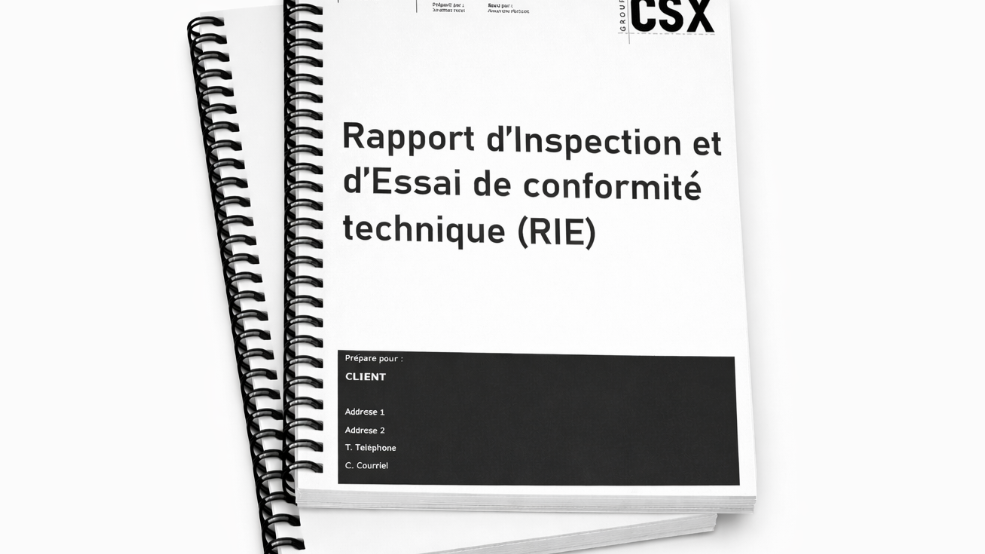
A technical assessment report is not a visit report; it's a document that produces contractual and regulatory effects. Yet, in practice, it is still all too often treated as a secondary delivery: a dated PDF, with no indication of revision, no explicit methodology, and no clear identification of signatories.
This structural lightness comes at a cost, which systematically reveals itself at the wrong moment.
A report without traceability is not a report, it's an opinion.
The value of a technical assessment lies in the chain that links each conclusion to its source: which measurement, carried out with which instrument, its calibration, according to which method, under which operating conditions, by whom. It is this chain that makes it possible to demonstrate compliance with requirements, to validate that the client's expectations have been met, and to defend the quality of the work carried out.
This is precisely what the ISO/IEC 17025:2017, These requirements are not mere formalities: they constitute a technical and contractual condition for the validity of the document. These requirements are not mere formalities of presentation: they constitute the condition for the technical and contractual validity of the document.
In the field of emergency communication systems, an STI value measured at 0.5 only makes operational sense if we know under which acoustic conditions it was obtained, according to which IEC 60268-16 procedure, with which calibrated equipment and at which date. Without these elements, the data can neither be compared with a previous measurement, nor serve as a contractual reference, nor attest to the system's compliance with the initial performance requirements.
Revision management: because the report lives in time
A report issued on provisional acceptance of work can be invoked twelve or eighteen months later, in the event of an incident, formal notice or insurance review. At that point, the question is not only what it says the document, but which version was in force, who approved it, and whether subsequent revisions have altered the original conclusions. The ability to answer these questions clearly is itself an indicator of quality maturity.
The standard ISO 9001:2015, dedicates an entire section to the control of documented information, setting out the basic requirements: identification, revision index, formal approval, protection against uncontrolled modifications. This framework imposes a simple discipline: any modification to the document produces a new index identified with date, author and description of the nature of the change.
This discipline transforms the report into a reliable record of the system's compliance status at every point in its lifecycle, which the verification and validation processes described in the ISO/IEC 15288:2023 (systems lifecycle) explicitly require traceability between the initial requirements and the proofs of conformity produced at each milestone.
Responsibility: naming what we say
A well-structured report explicitly identifies who carried out the tests, who drafted the conclusions and who validated the document. This identification is not just symbolic: it forms the basis of any demonstration of conformity and any attribution of professional responsibility.
Standards IEC 61508 and IEC 61511, In this respect, our new standards for functional safety and safety instrumented systems in industrial process environments introduce the concept of the safety case: a structured, traceable set of documents which demonstrates, in a substantiated and verifiable manner, that the required level of safety has been achieved, and that the requirements have been met in full. This model is directly transposable to the assessment reports of any critical system: each conclusion must be linked to a proof, each proof to a method, each method to an identified person in charge.
The standard ISO/IEC/IEEE 29119-3, which defines the formal structure of test documents in systems engineering, formalizes this logic through standardized templates including identification fields, revision index and traceability of deviations, confirming that this requirement for rigor cuts across the whole of systems engineering, far beyond any particular sector.
In complex, multi-disciplinary projects involving OHS teams, integrators, specialist subcontractors and client representatives, the absence of individual signatures on an assessment report makes it impossible to reconstruct the decision-making process. Who approved the conformity of zone X? On the basis of what measurement? On what date? These questions seem abstract during the commissioning phase. They become very concrete when the quality of the system is called into question.
What structure reveals about process maturity
The form of a document says something about the rigor of the process that produced it.
An assessment report structured according to the requirements of ISO/IEC 17025, controlled according to the principles of ISO 9001 and anchored in the traceability logic of IEC 61511, with revision and approval index, explicit methodology section, referenced appendices and modification history, signals that the organization that produced it treats conformity and quality as structuring commitments, and not as project closing formalities.
For life-safety emergency communication systems, industry standards presuppose precisely this documentary rigor. Following them to the letter without mastering the meta-normative framework exposes compliance gaps that only become apparent after the fact.
Rigorous documentation is not an administrative constraint. It is an integral part of assessment quality, compliance with requirements and respect for the expectations of all stakeholders.
CSX Group Inc. | By Jonathan Henri, Senior Director - Design and Compliance
Any further questions? Please do not hesitate to contact the author. jonathan.henri@groupecsx.ca
Last revised: 2026-04-10
Linguistic advice: In this article, the use of pronouns in the masculine or feminine, singular or plural, does not imply any bias or exclusion based on gender. The linguistic choice is intended solely to enhance the readability and fluidity of the text.
Normative references
- ISO/IEC 17025:2017 - General requirements for the competence of testing and calibration laboratories
- ISO 9001:2015 - Quality management systems
- IEC 61508 - Functional safety of safety-related electrical/electronic/programmable electronic systems
- IEC 61511 - Functional safety - Safety instrumented systems for the process industry sector
- ISO/IEC 15288:2023 - Systems and software engineering - Systems lifecycle processes
- ISO/IEC/IEEE 29119-3 - Software testing - Test documentation